Comparing Car AC Service Options in Dubai are not optional when cabin temperatures in a parked car regularly hit 70°C during summer. A failed cooling system becomes a genuine safety issue for everyone inside, not just an inconvenience. This is not a worst-case scenario; it is a documented reality for vehicles left in direct sun when outdoor temperatures exceed 45°C. At PIT PROS Auto Maintenance Dubai, the workshop sees a surge in AC-related walk-ins every May, and most of them share a common thread: the driver either waited too long to act, or tried a DIY fix that bought a few weeks before the problem came back worse. This article is a practical guide for making the right call. You will learn what real AC problems look like in the UAE climate, what a full professional service actually covers, where DIY recharge kits make sense, and where they fall short. Concrete cost ranges and turnaround times are included so you can decide and act with confidence.
Why Dubai’s climate pushes car AC systems to their limit
Ambient temperatures above 45°C force the compressor to run almost continuously. Unlike temperate climates where the compressor cycles on and off throughout a journey, Dubai driving conditions keep it under sustained load for most of the trip. That constant engagement puts serious pressure on the refrigerant circuit, drive belts, and seals in ways that drivers elsewhere rarely experience. The condenser faces an additional problem: it must reject heat into ambient air that is already 45 to 50°C, which dramatically reduces its efficiency.
When you add accumulated sand and dust blocking the condenser fins, the system works even harder to deliver the same cooling output. The result is faster refrigerant depletion, premature compressor wear, and a shortened service life across every component in the circuit. The specific failure patterns most common in UAE conditions reflect this environment directly. Refrigerant leaks develop from seals and O-rings that expand and contract repeatedly under extreme heat. Condensers clog from desert dust. Evaporators develop mold from the constant cycling between high humidity and dry recirculated air. Compressor clutches burn out from continuous engagement. These are not generic AC faults; they are climate-specific failures that require proper diagnosis, not just a gas topup.
Warning signs your car’s air conditioning needs attention
Symptoms you can spot without a mechanic
Weak or warm airflow is the most obvious signal: the cabin takes longer to cool, air is only slightly colder than outside, or cooling drops noticeably at idle compared to highway speed. This typically points to low refrigerant, a restricted cabin filter, or a condenser that can no longer shed heat efficiently. Any of these causes will get worse, not better, without intervention. Musty or moldy odors from the vents signal evaporator contamination or a dirty cabin filter, both of which are straightforward to address in a service visit. A burning or chemical smell is a different matter and requires same-day inspection. Clicking on compressor startup is generally normal, but grinding, rattling, or squealing noises during AC engagement are not. Visible oily residue around hose fittings or service ports under the bonnet is almost always a refrigerant leak marker.
Quick checks you can do before calling a workshop
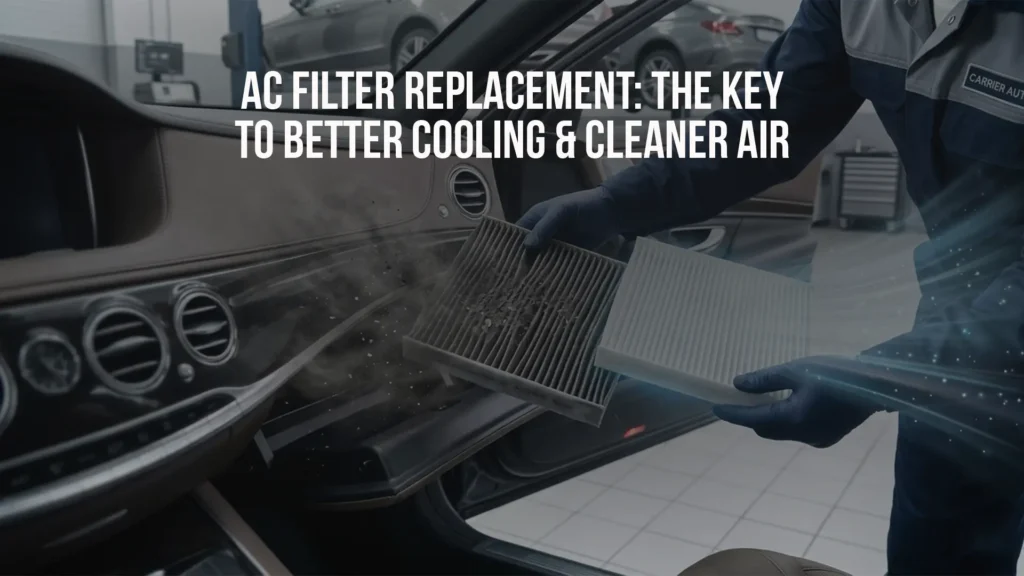
Start the engine and set the controls to maximum cooling, dashboard vents, high fan speed, and recirculation mode, then confirm the AC indicator is illuminated. Run the system through every fan speed; if airflow does not change between settings, the blower motor, resistor, or a fuse is likely the problem rather than the refrigerant circuit. Check that all vents are open, and if the cabin filter is accessible, pull it out for a visual inspection. A heavily clogged filter restricts airflow enough to make a functioning AC system feel like it is barely working. With the engine off, take a safe look under the bonnet for belt condition, hose damage, and oily residue around refrigerant lines and fittings.
Do not open any refrigerant service ports. One clarification worth making: clear water dripping under the car during or after AC use is normal condensation from the evaporator drain. Water pooling inside the cabin is not normal and points to a blocked evaporator drain that needs clearing. Note the difference before you call the workshop so the technician can prioritize correctly.
What full professional car AC services include (and what they cost)
The service process from first check to final sign-off
A complete car AC service is considerably more involved than simply adding gas. The process starts with an initial performance check: recording the complaint, ambient temperature, and center-vent temperature before any work begins. The technician then conducts a full visual inspection covering the compressor body, drive belt, condenser fins, refrigerant hoses, O-rings, service ports, and cabin filter. Electrical components including the compressor clutch, condenser fan, pressure switches, and relevant fault codes are checked before any refrigerant work starts. Electronic leak detection comes next, scanning all joints, O-rings, and service ports with an approved detector. If a leak is confirmed, it must be repaired before recharging. The existing refrigerant is recovered rather than vented, weighed against the vehicle specification, and the system is then evacuated with a vacuum pump to remove moisture and air before the correct refrigerant is added by weight using calibrated scales. A recharge alone is not a full service. It may restore cooling temporarily but does not confirm the system is leak-free, that the compressor is functioning correctly, or that the condenser and cabin filter are serviceable.
Realistic costs and turnaround in Dubai
A basic gas top-up in Dubai runs approximately AED 150 to 300. A full car AC service that includes vacuuming, electronic leak detection, pressure testing both sides, refrigerant recovery and recharge, cabin filter check, and final vent-temperature verification typically costs AED 250 to 600. Most full services at a properly equipped workshop are completed within 60 to 90 minutes when no component repair is needed. If a leak is found in an accessible location such as a hose, O-ring, or condenser joint, add roughly two to four hours. An evaporator leak requiring dashboard removal is a different job entirely and can take a full day or more. Vehicle age determines your refrigerant costs significantly. Older vehicles use R-134a, which is widely available and less expensive. Many vehicles from around 2017 onward use R-1234yf, which is classified as mildly flammable and costs considerably more, pushing full-service pricing toward the upper end of the AED 350 to 600+ range for those vehicles. The refrigerant type your vehicle requires is printed on the specification label under the bonnet, always confirm it there before booking.
Why your refrigerant type changes everything -Comparing Car AC Service Options in Dubai
R-134a and R-1234yf use different fittings, compressor oils, service equipment, and handling protocols. They must never be mixed. A workshop that does not identify the refrigerant type before beginning work is a serious red flag. The definitive source is the vehicle label under the bonnet, not the model year alone. Some manufacturers began transitioning earlier or later than the general 2017 reference point, so always confirm from the label before booking.
The honest case for DIY refrigerant recharge kits (and where they fall short)
DIY recharge kits sold in UAE auto stores connect to the low-pressure service port, add refrigerant, and use a basic gauge to estimate system pressure. For a vehicle that has lost a very small amount of charge over several years of normal operation with no active leak, this can restore short-term cooling in about 15 to 20 minutes at a fraction of the cost of professional car AC services. The catch is that this best-case scenario applies to a narrow set of circumstances. The practical problem is that low refrigerant almost always means there is a leak. A DIY kit adds gas without finding or fixing the source. Within weeks in Dubai’s heat, the charge depletes again, and the driver pays for another kit. More critically, consumer kits cannot vacuum the system before recharging, cannot conduct electronic leak detection, and cannot inspect the compressor, condenser fan, or cabin filter. Repeated recharges mask the underlying problem and can cause overcharging damage that shortens compressor life. There are also safety and legal limits to consider. R-1234yf is classified as mildly flammable (A2L) and requires dedicated recovery equipment and trained handling. UAE good practice, aligned with international environmental standards and Federal Law No. 24 of 1999, requires refrigerant to be recovered rather than vented and systems to be charged by weight using calibrated scales. A standard consumer kit does not meet these requirements for R-1234yf systems, and repeatedly venting refrigerant to the atmosphere is not compliant practice.
When professional car AC services are clearly the right call
An emergency breakdown is the most urgent case: AC suddenly stops blowing cold mid-drive during peak summer. Driving with windows down above 42°C is not a safe alternative, particularly with children or elderly passengers in the vehicle. Mobile AC technicians operate across Dubai and can reach most locations within 30 to 45 minutes, though a workshop with fast-track diagnostics is the better option when you can get there safely. A pre-road trip check is the second common scenario. Before a long drive to Abu Dhabi or up to Fujairah through the mountains, a quick car air conditioning service UAE-style inspection covering refrigerant pressure, cabin filter condition, and compressor belt integrity costs very little and prevents a breakdown two hours from home. A partial system that works fine in city traffic can fail completely under sustained highway load in peak heat. Fleet maintenance rounds out the picture. Small business owners running delivery or transport vehicles cannot afford individual AC breakdowns that take a driver off the road for a day. Scheduled quarterly or pre-summer car AC repair Dubai workshops are significantly cheaper per vehicle than emergency callouts, and the operational reliability is worth considerably more than the service cost.
Why PIT PROS Auto Maintenance Dubai is the practical choice for Dubai motorists
PIT PROS Auto Maintenance Dubai offers fast AC diagnostics without the multi-day waits that come with dealership service centers. The workshop handles both R-134a and modern R-1234yf systems with the correct dedicated equipment, so there is no risk of refrigerant misidentification or cross-contamination. Pricing is transparent before any work begins: you know what you are paying for before the technician picks up a tool. Combining an AC service with an oil change and tire check in a single visit saves time for busy Dubai residents and reduces the total visit count across the year. Fleet operators can arrange priority scheduling to minimize vehicle downtime. For drivers who want reliable car AC services without dealership pricing, PIT PROS is the fully equipped, practical alternative in Dubai.
Keeping your car AC services and systems healthy through the Dubai summer
A practical pre-summer checklist
A single annual visit in March or April prevents the majority of mid-summer emergency failures. The checklist covers four items: cabin filter inspection and replacement if needed, compressor belt condition check, condenser cleaning to clear accumulated sand and debris from winter and spring, and a pressure check to confirm refrigerant levels before the system is tested to its limits daily. This visit costs far less than the AED 1,200 to 2,500+ price range of a compressor replacement that a missed warning sign can lead to.
Day-to-day habits that reduce system strain
Four habits make a measurable difference to AC system longevity. First, park in shade or use a windshield reflector to reduce cabin heat soak before the AC has to work. A car that starts at 45°C instead of 75°C puts far less initial load on the compressor. Second, run the AC on recirculation mode during the hottest part of the day to avoid drawing in superheated external air continuously. Third, turn the system off two minutes before you park. This dries the evaporator surface before shutdown and significantly reduces the mold and odor buildup that Dubai’s humidity-to-dry-air cycling creates. Fourth, do not blast the AC at maximum the moment you start the car. Ventilate the cabin first by opening windows briefly to exhaust the trapped hot air, then let the engine reach operating temperature before gradually increasing the AC load. These habits do not require extra cost or time; they just require consistency.
The bottom line: making the right call before summer does it for you
DIY recharge kits have a narrow, legitimate use case for minor charge loss with no active leak and no other symptoms. For anything else in Dubai’s conditions, including any leak, noise, odor, weak airflow, or a scheduled pre-season check, professional car AC services are the faster and cheaper long-term option. The math is straightforward: an AED 250 to 400 service now versus an AED 1,500 to 2,500+ compressor replacement later, separated by one missed warning sign. For Dubai motorists who want the job done right the first time, PIT PROS Auto Maintenance Dubai offers the full range of car AC services with same-session diagnostics, honest upfront pricing, and the option to combine with an oil change or tire check in a single visit. Whether it is routine summer prep in April or an urgent cooling failure in July, reach out to the team at PIT PROS and get it sorted before the heat makes the decision for you.